The planning habit and its quiet effects
Meal planning is often presented in contemporary nutrition writing as a productivity exercise — a way to save time, reduce food waste, and achieve specific dietary targets. The framing tends to position planning as an efficiency tool, which is accurate but incomplete. The more interesting observation is what planning does to the actual composition of meals over a week, independent of any efficiency gain.
When people plan meals in advance, even loosely, they tend to think across a longer time horizon than the immediate meal. A person deciding tonight's dinner in isolation is likely to reach for something familiar, accessible, and satisfying. A person sketching out five dinners at once is implicitly aware of repetition — and tends to introduce variety, sometimes without articulating why.
This distributed awareness across a week's meals appears to produce more consistent inclusion of vegetables and whole grain ingredients, more considered portion compositions, and — as a secondary effect — more regular shopping habits that support better ingredient quality over time.
What "low-friction" planning actually means
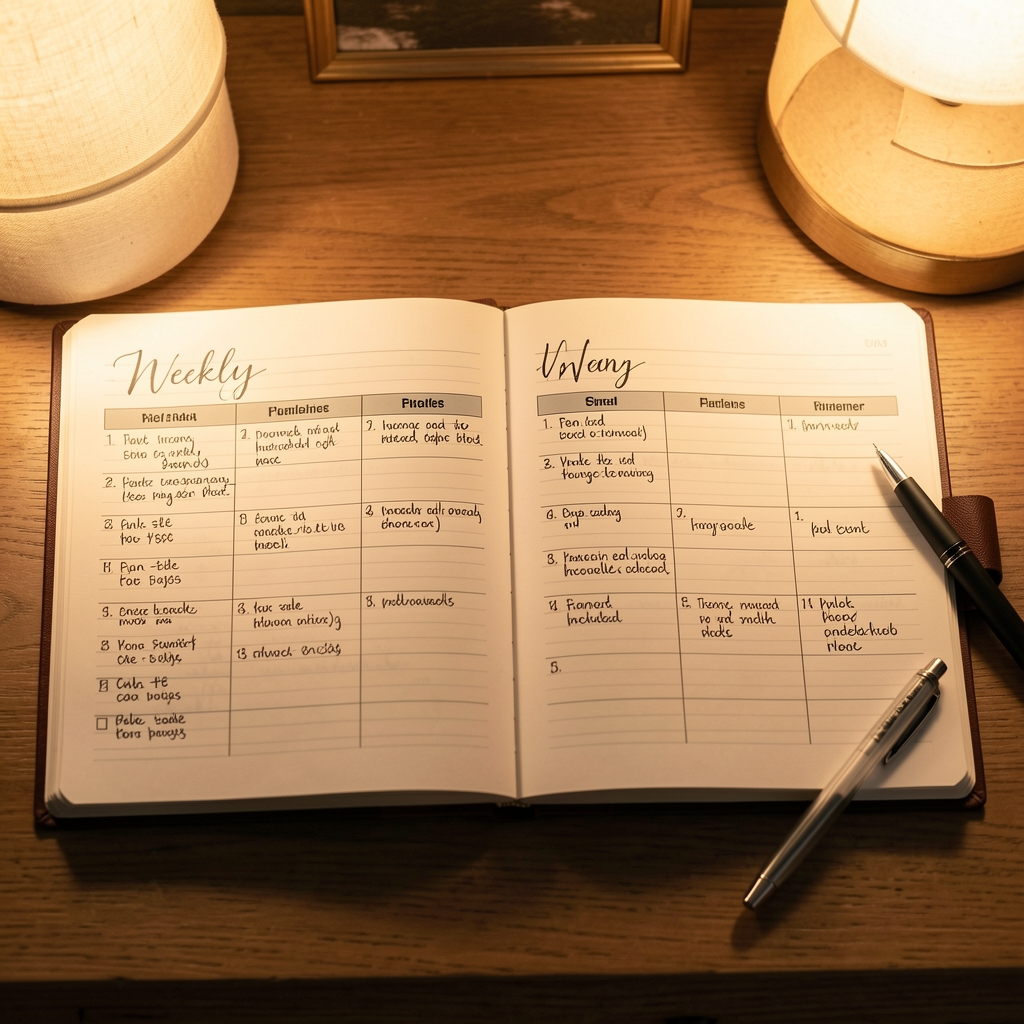
There is a version of meal planning that involves detailed spreadsheets, nutritional tracking applications, and precise portioning instructions. This is not what the cooks observed in this entry were doing. Their planning practice was, by any measure, minimal: a few lines in a notebook, or a rough mental list revisited on a Sunday afternoon.
The low-friction character of the habit appears to be central to its persistence. Among the cooks interviewed, those who had attempted more rigorous planning systems described abandoning them within a few weeks, returning to unplanned daily decisions. Those who maintained the notebook habit described it as requiring very little time — "ten minutes, sometimes less" — and rarely involving precise quantities.
The insight here for everyday nutrition practice is that the method matters less than the fact of having one at all. A rough weekly list, revisited and adjusted, produces the distributional effects described above — more variety, more whole foods, fewer impulse substitutions — without the cognitive overhead of detailed tracking.
"A plan that is revisited on a Tuesday because Monday changed is still a plan. The act of returning to it, adjusting it, and finishing the week with any version of it intact is the practice."
Whole foods and the planning advantage
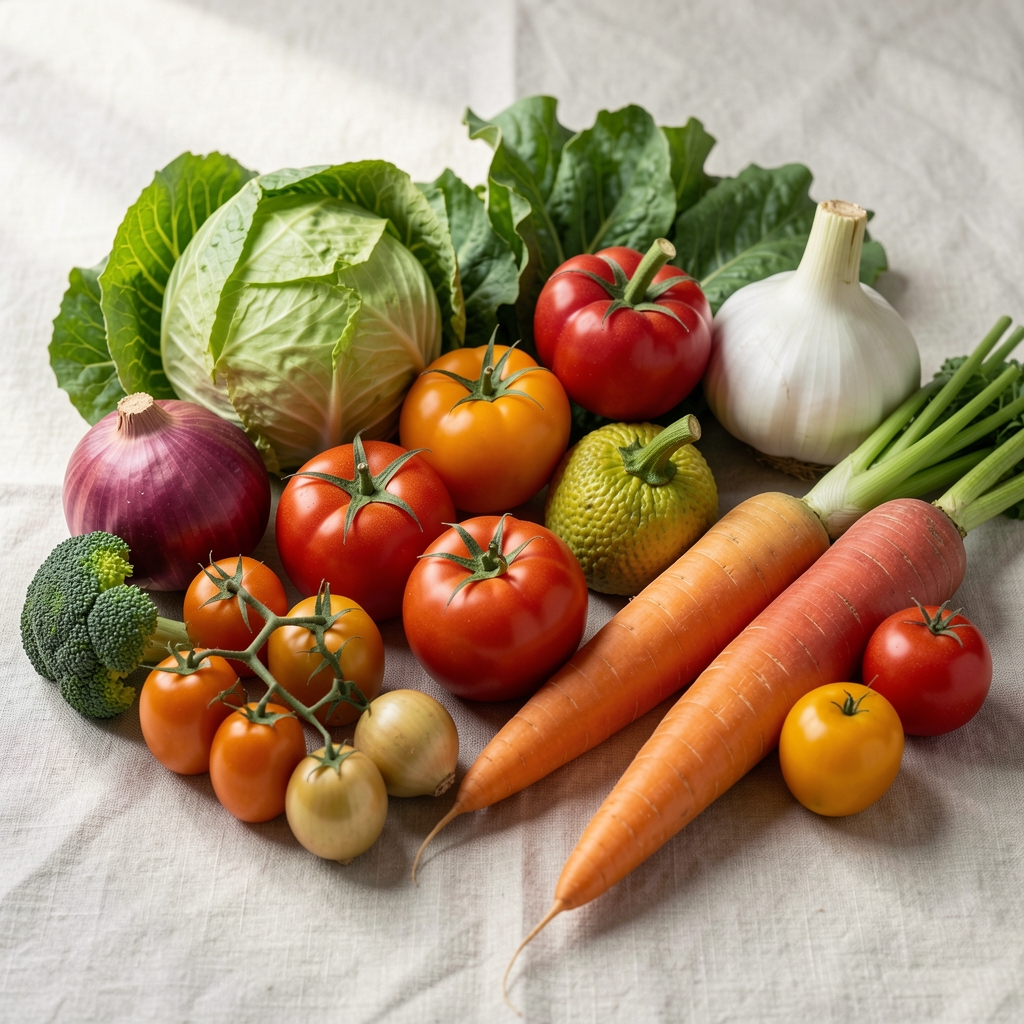
Whole foods — vegetables, legumes, whole grains, fruits, unprocessed proteins — require slightly more preparation time than their processed counterparts. This is the practical barrier that makes them less likely to appear in unplanned meals at the end of a long day: they require a prior decision to be present in the kitchen at all.
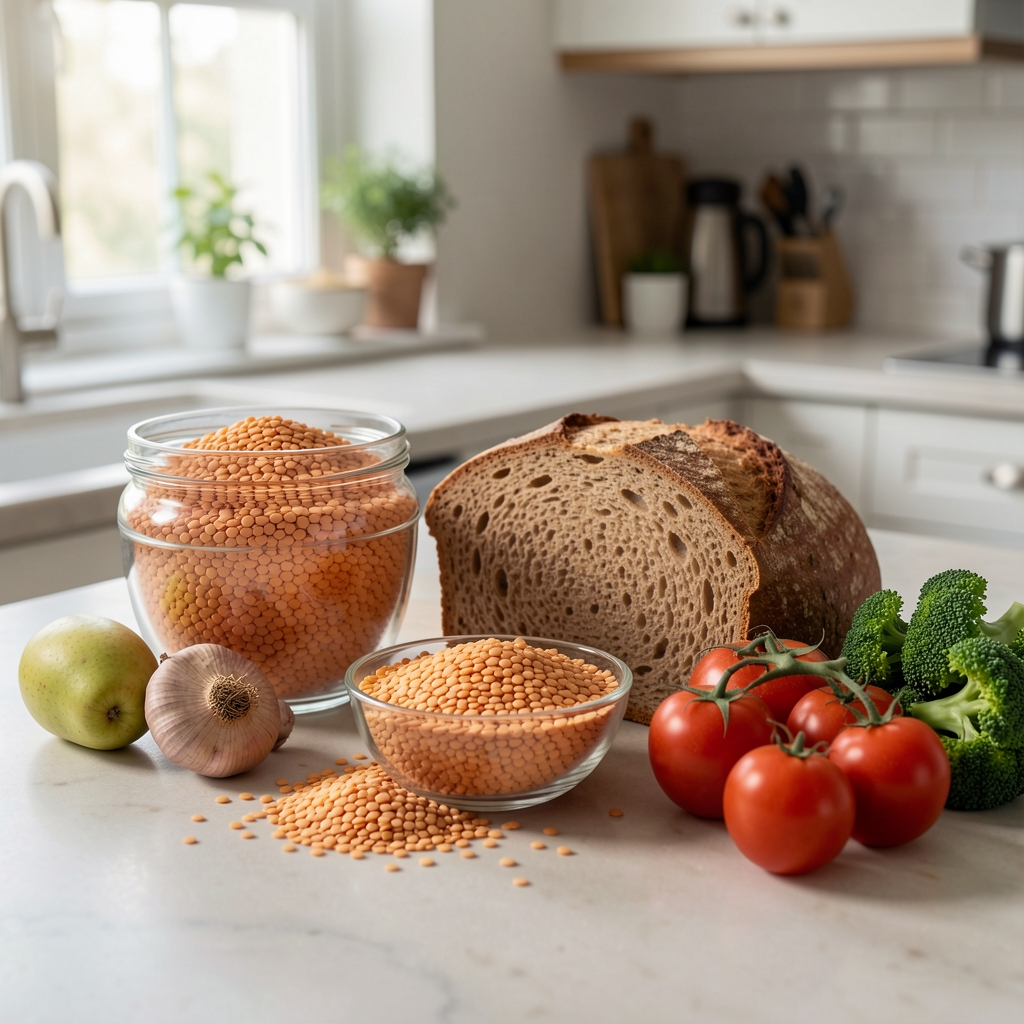
When meals are planned in advance, even loosely, the decision to include whole grain bread, or to have dried lentils in the cupboard, or to obtain the less-convenient broccoli alongside the ready-to-use frozen equivalent, is made at the planning stage rather than at the cooking stage. This temporal shift is significant. Decisions made during calm planning sessions are less subject to tiredness, time pressure, and the reduced patience that follows a demanding day.
The pattern is consistent across the households observed for this entry: those planning in advance had better stocked kitchens, with a wider variety of whole food ingredients available across the week. Those cooking unplanned relied more heavily on ingredients that required no pre-purchase decision — which, in practice, meant more processed and semi-processed items.
Mindful eating as a consequence, not a practice
The phrase "mindful eating" circulates widely in wellness writing, often associated with specific practices: eating slowly, chewing thoroughly, eliminating distractions. These are genuine behavioural practices with reasonable evidence behind them. What is less often noted is the degree to which meal planning creates conditions for a version of mindful eating that requires no deliberate in-meal practice at all.
When the composition of a meal has been considered in advance — even briefly — the eater arrives at the table with a different relationship to the food than someone who assembled the meal under pressure. The plate is not a surprise. Its components were chosen. That prior consideration introduces a degree of intentionality that shapes the eating experience without requiring any technique at the table.
This is a different frame for mindful eating than the one typically presented: not as attention to the act of eating, but as attention to the act of planning what will be eaten. The former is difficult to sustain under normal daily conditions. The latter requires ten minutes, once a week, at a quiet moment.
The portion awareness dimension
Portion control — the management of how much is eaten at a single sitting — is an area of everyday nutrition where planning has a straightforward, observable effect. When a meal's components are prepared in advance with an expectation of what will constitute a serving, the quantity cooked tends to match that expectation. When meals are assembled reactively, there is a well-documented tendency to use whatever is conveniently available, producing inconsistent portions.
This is not a precise finding — the cooks in this entry were not measuring portions. But the qualitative observation is consistent: planned meals appeared more deliberately composed, with the components in clearer proportion to one another. Unplanned meals tended to default to whatever was easiest to prepare quickly, without consideration of the relative proportions of different food types.
The planning habit, as practised by the households documented here, does not produce calorie-counted portions. It produces considered portions — meals where the cook had at least briefly thought about what would constitute a sensible quantity before beginning to cook, which turns out to be a reliable enough proxy for appropriate serving sizes across a week.
An argument for the uncomplicated list
The conclusion of this entry is deliberately modest. It does not argue for any particular system of meal planning, any specific dietary framework, or any technology designed to optimise nutrition intake. It observes that the simple act of writing down, at some point before the week begins, what you intend to eat across the coming days produces consistent, durable effects on the quality and variety of food consumed.
The research base on meal planning and dietary quality supports this direction. Studies of planned versus unplanned eating habits consistently note associations between planning frequency and higher vegetable consumption, greater whole food intake, and more stable weight patterns over time. These are associations, not certainties, and they apply in the aggregate rather than uniformly.
For the purposes of this almanac's record, the observation stands on its own without requiring the research context to make it useful: a rough list, kept lightly, revised freely, and returned to at the end of the week to note what actually happened, is a sufficient practice. It requires no particular commitment, no specific tools, and no system beyond the notebook or the back of an envelope.
Key observations from this entry
- Weekly meal planning, even in rough form, produces greater variety of whole foods across the week than day-by-day or unplanned eating.
- Low-friction planning formats (brief notebook entries, loose lists) are more durable than detailed nutritional tracking systems.
- Whole foods require a pre-purchase decision; planning shifts that decision to a calmer context, increasing their likelihood of appearing in meals.
- Intentional meal composition in advance creates a background form of considered eating without requiring specific in-meal practices.
- Consistent planning is associated with more stable weight patterns across population studies — an aggregate observation, not a personal guarantee.